
Navigating the Invisible Threat Safeguarding Against GNSS Attacks at Sea
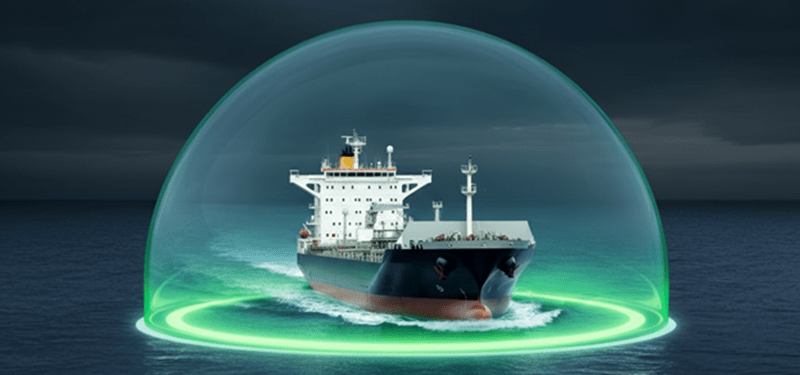
 In a single 24-hour period in early 2026, more than 1,100 vessels in the Arabian Gulf were reportedly affected by GPS jamming and spoofing — appearing in incorrect locations, with degraded AIS data and elevated collision risk across one of the world's busiest shipping corridors.
The Hidden Cost of GNSS Dependency
The integration of GNSS technology has transformed maritime navigation. Ships can now determine their positions with remarkable precision in remote and challenging environments, enabling more efficient routes, optimized fuel consumption, and enhanced safety at sea.
But that dependency comes with a hidden cost. As satellite based positioning has become fundamental to maritime operations, it has also created a concentrated vulnerability —
one that malicious actors are actively exploiting. The threat is no longer theoretical. It is operational, it is growing, and it is arriving in waters that matter.
Understanding the Threats: Spoofing and Jamming
Two distinct attack types define the current threat landscape. Understanding the difference is the first step toward building a credible defense.
| Spoofing False GPS signals are broadcast to mimic or override genuine ones, causing a receiver to report an incorrect position. The danger lies in its silence: the navigation system appears to function normally while the vessel drifts off course. No alarms. No obvious errors. By the time the crew detects something is wrong, the margin for safe correction may already be gone. |
Jamming Strong signals are transmitted on the same frequency as GPS, drowning out legitimate positioning data. Unlike spoofing, jamming announces itself through lost signal — but in busy shipping lanes, narrow channels, or during port approaches, even a brief loss of positioning can create an immediate navigational emergency. |
"A successfully
spoofed navigation system may show no obvious errors while the vessel gradually
veers off course — entering restricted waters or hazards without any apparent
warning signs."
The Real-World Impact
For maritime operators, the consequences of a successful GNSS attack are severe: accidental entry into restricted zones, collision or grounding risk, delayed port arrivals, cargo delivery penalties, and compromised emergency response due to unreliable position data.
A Royal Institute of Navigation (RIN) study on GNSS interference confirmed that these vulnerabilities extend beyond navigation systems to SOLAS-mandated safety equipment, including the Global Maritime Distress and Safety System (GMDSS). The study documented hundreds of vessels experiencing interference daily, with incidents linked to collisions and groundings in strategically important maritime regions.
The early 2026 events in the Arabian Gulf were a stark illustration of the systemic scale of this risk. More than 1,100 ships were affected in a single 24-hour window — vessels appearing on land, at airports, or near critical infrastructure. Degraded AIS data made safe navigation significantly more challenging across one of the world's most transit-critical corridors.
Building a Layered Defense: Five Best Practices
Protecting against GNSS attacks requires a layered approach — no single measure is sufficient. The following represent current best practices for maritime GNSS resilience.
1. Diversify navigation sources
Radar, sonar, and inertial navigation systems should complement GNSS, not defer to it. Reducing dependency on any single source is the foundation of a resilient navigation
architecture.
2. Deploy multi-constellation GNSS receivers
Receivers tracking GPS, Galileo, BeiDou, and GLONASS simultaneously force attackers to spoof or jam multiple simultaneously force attackers to spoof or jam multiple
independent systems at once — significantly raising the complexity and cost of a successful attack.
3. Implement signal authentication
Authentication mechanisms verify the legitimacy of signals received from satellites, providing a technical baseline for detecting spoofing attempts before they influence positioning output.
4. Establish regular testing and maintenance protocols
Periodic assessment of navigation systems identifies vulnerabilities before they become critical. Consistent maintenance ensures systems perform as expected when conditions deteriorate.
5. Invest in crew training
Technology alone is insufficient. Crew members who understand what spoofing and jamming look like in practice — and who know how to respond — are the last line of defense when systems produce anomalous data.
The IMO has reinforced many of these principles through published guidelines emphasizing multi-system GNSS adoption and redundancy — recognizing that no single constellation should be a single point of failure in safety-critical navigation.
Independent Verification During Critical Operations
Technological advancement has materially changed what is achievable in GNSS threat detection — particularly during the high-stakes moments of port approach, confined-water transit, and pilotage.
TRELLEBORG SOLUTION
SafePilot CAT PRO & CAT MAX Portable Piloting Units
The CAT PRO and CAT MAX continuously monitor GNSS signal behavior using a combination of detection techniques. Anomalous signal levels — sudden increases, satellite inconsistencies, or behaviour that deviates from expected patterns — trigger early warnings even when the navigation system continues to produce a valid-looking position fix.
Signal fingerprinting compares received signals against known authentic characteristics — strength, modulation, timing — to identify inconsistencies indicative of spoofing. The CAT MAX extends this further with a six-axis inertial measurement unit (IMU) that cross-references actual vessel motion against incoming GNSS signals, identifying the divergences that spoofed data inevitably produces.
When used with SafePilot navigation app, pilots receive a unified real-time view of vessel movement, positioning quality, and active alerts within a single piloting interface — supporting informed decision-making at the moments that matter most.
At the vessel level, SafeCaptain navigation app combined with the P1+ or P3 fixed navigation units extends the same layered resilience approach to ship captains — creating a cyber-physical defense architecture that covers both pilotage and ongoing passage operations.
Building a Resilient Navigation Strategy
The maritime industry faces a persistent tension between the efficiency gains of advanced navigation technology and the cyber risks those systems introduce. Forward-thinking operators are resolving that tension not by limiting technology adoption, but by building resilience into the architecture around it.
The most effective strategies combine technical layering, operational protocols, and crew awareness — and treat navigation security not as a compliance exercise, but as an
ongoing operational discipline. Threats evolve. Defenses must evolve with them.
The wider maritime community has a role to play as well. Sharing intelligence on emerging interference patterns, successful detection approaches, and incident response lessons is how the industry collectively stays ahead of those seeking to exploit these vulnerabilities — at a systemic level, not just vessel by vessel.
Strengthen Your Navigation Resilience
Speak with our team about how Trelleborg's solutions can provide an independent layer of assurance for your operations