
Meet the Pioneers - Mishra Kumar
Date: 25.11.25
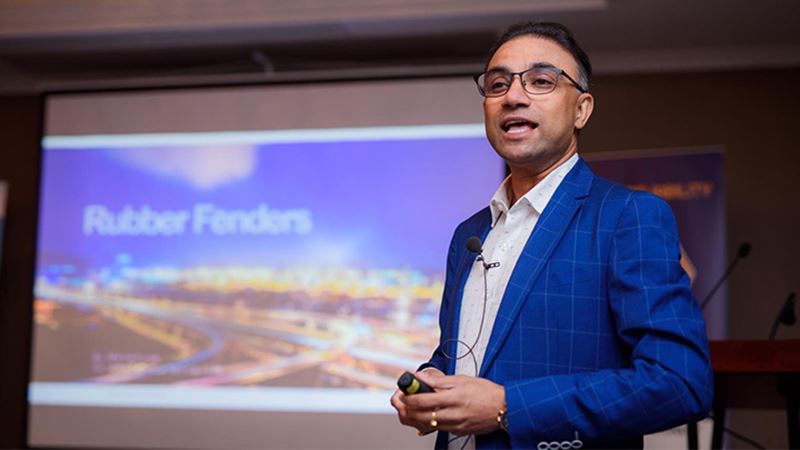
Mishra Kumar, our Business Unit Director – Innovation and Technology reflects on over 20 years at Trelleborg, sharing his journey, expertise in polymer science, leadership in sustainability and efforts to promote industry collaboration. Mishra touches on the roll out of Environmental Product Declaration (EPDs), customer expectations and the future of sustainable practices in the marine and infrastructure sectors.
Can you share your journey with Trelleborg since you joined in 2001 and how your role has evolved over the years?
In 2001, I moved to Singapore with my family. At that point, I was seeking a role aligned with my background in Polymer Science & Technology and Chemical Engineering and eventually I joined Trelleborg as a Production Supervisor, eager to gain hands-on experience in a multinational environment.
Over the years, I advanced through roles in production, technical management, and commercial support, contributing to global projects, including a greenfield facility in China. Now, as Business Unit Director for R&D, I remain committed to driving innovation, technology, and sustainability within the Marine & Infrastructure business unit. Trelleborg’s recognition of hard work and dedication continues to inspire me to contribute my best to the business’ growth and capability-building.
What inspired you to specialize in rubber technology, and how has your background in polymer science and chemical technology informed your approach to research and product development?
I initially aspired to be a teacher, but my journey shifted after pursuing polymer science and chemical technology. My interest in rubber technology began during my first R&D role at a tire manufacturing company, where I developed a passion for understanding the characteristics of rubber, applications, and processing methods such as extrusion, calendaring, milling, and curing. I gained valuable insights into rubber mixing and vulcanization chemistry, as well as evaluating quality and physical properties using specialized testing equipment.
This combination of theoretical knowledge and practical experience proved invaluable in my current role at Trelleborg. It has equipped me with a deep understanding of product development and manufacturing processes, enabling me to approach research and innovation holistically. By integrating technical expertise with practical awareness, I ensure our solutions are not only advanced but also manufacturable and sustainable.
Since leading the sustainability initiatives for Trelleborg Marine and Infrastructure, can you walk us through some of the key milestones you've achieved?
Sustainability is embedded in our strategy at Trelleborg Marine and Infrastructure, with a focus on reducing our carbon footprint, circularity, waste reduction, and sustainable product disposal. Since starting our sustainability journey in 2021, we’ve reduced operational carbon emissions from 11,687 tons of CO₂ to 5,800 tons by 2024 - a 50% reduction in three years. This was achieved through measures like optimizing fender curing times, switching to 100% renewable electricity, installing solar panels, improving energy efficiency in machinery, and implementing energy recovery systems.
We’ve also set a target to include 25% bio-based or recycled materials in our products by 2030. Transparency is a key aspect of our approach, and we’ve introduced Environmental Product Declarations (EPDs) backed by third-party Life Cycle Assessments (LCAs), providing customers with credible data on the environmental impact of our products.
What were some of the initial challenges in embedding sustainability into operations, and how did you overcome them?
Embedding sustainability posed challenges, including a lack of shared understanding of what sustainability meant in a manufacturing context and the absence of unified global standards. Different levels of awareness and adoption across regions added complexity, as did the challenge of calculating Scope 1, 2, and 3 carbon emissions without historical data.
We addressed these by setting manageable short-term targets aligned with our long-term vision, implementing a consistent global strategy, and showcasing tangible outcomes. Communication and education were crucial to driving cultural shifts within the organization. We also focused on material innovation, evaluating bio-based and recycled alternatives across key materials while ensuring performance and environmental gains.
From your perspective, why are sustainable practices becoming increasingly critical for manufacturing businesses today?
Sustainable practices are essential for the long-term survival of manufacturing businesses. Overconsumption of natural resources, currently 1.8 times the planet’s regenerative capacity, underscores the need for smarter, circular approaches like reusing and recycling. Businesses are now expected to deliver high-quality products responsibly, minimizing environmental impact.
Sustainability also offers operational benefits, such as reduced energy consumption, waste minimization, and cost efficiencies, while addressing rising regulatory pressures. Beyond economics, sustainability is about stewardship - preserving resources for future generations. Manufacturers must innovate to decouple economic growth from environmental degradation, and that future starts with the choices we make today.
What shifts are you seeing in customer expectations regarding sustainable products evolving in the maritime and infrastructure sectors?
Customer expectations in sustainability vary widely. Some are well-informed and committed, actively seeking data-driven solutions like EPDs and low-carbon products. Others have limited knowledge but show growing interest and rely on us for guidance. Some prioritize cost and show little interest in sustainability, though this mindset is gradually shifting with tighter regulations and increased awareness.
Regional differences also play a role. European customers lead in sustainability requirements, often including Life Cycle Assessments (LCAs) and EPDs in specifications, while the U.S. and Asia are catching up. Overall, customer expectations are steadily rising, with sustainability becoming a critical factor in decision-making.
What regulatory developments do you foresee shaping sustainability requirements in these sectors?
Sustainability regulations can be grouped into ongoing and upcoming requirements. Ongoing regulations include the European Union Deforestation Regulation (EUDR), Corporate Sustainability Reporting Directive (CSRD), and PFAS regulation, requiring compliance in sourcing, reporting, and chemical inventory reviews. Upcoming regulations include the Corporate Sustainability Due Diligence Directive (CSDDD), Digital Product Passports (DPP), and the EU Green Claims Directive (EUGCD), focusing on transparency, circularity, and environmental accountability.
While these regulations are EU-driven, we anticipate similar legislation globally as sustainability becomes central to economic strategies.
Could you provide insights into your Environmental Product Declarations (EPDs) program and how it began with the Gina Gasket product line?
EPDs are verified environmental statements prepared under ISO standards, starting with LCAs to assess a product’s full life cycle impact. Our first EPD was developed for the Gina Gasket, used in the Fehmarnbelt Tunnel, Europe’s largest infrastructure project, which required the highest standards of environmental transparency. By producing the Gina Gasket EPD, we set a benchmark for environmental data reliability, reinforcing customer trust and aligning with sustainability goals.
The Gina Gasket’s critical role in sealing tunnel blocks made it a priority candidate for this initiative. Transparency is key to sustainability, and our EPD program reflects this commitment.
How do you collaborate with suppliers and value chain partners to drive sustainability and balance innovation with practicality?
Engaging suppliers is critical but challenging. Developing sustainable products requires close collaboration to balance material innovation with manufacturing practicality. Suppliers play a vital role, contributing technical knowledge and critical data for carbon footprint calculations. In some cases, we’ve jointly conducted research to optimize formulations for better sustainability performance.
While sustainable materials may initially be costlier, suppliers are innovating to create more affordable alternatives. By fostering collaboration, sharing data, and aligning goals, we’re building a more sustainable value chain capable of driving industry-wide impact.
Which sustainability innovations in materials or processes are you most excited about for the future of the maritime and infrastructure sectors?
Optimizing curing time for thick rubber products using Finite Element Analysis (FEA) is one exciting innovation. This approach has reduced energy consumption and carbon footprint without compromising product performance. Another promising development is pyrolysis, which allows us to recover recycled carbon black and other components from end-of-life rubber products, addressing a significant challenge in rubber waste management and advancing circularity in the industry.
What advice would you offer to manufacturing companies embarking on their sustainability journey?
Treat sustainability as a strategic opportunity, not just a responsibility. Start early, as results take time, and set clear, measurable goals with a strong implementation strategy. Engage employees at every level to integrate sustainability into the organizational culture. Focus on genuine impact, avoid greenwashing, and invest in initiatives that deliver real environmental benefits. With the right mindset and commitment, the results will follow.
From your perspective, what steps can the industry take to foster stronger collaboration and effectively tackle sustainability challenges?
The industry must prioritize collaboration over competition, sharing knowledge, data, and best practices to bridge the sustainability knowledge gap. Collaboration with academic institutions can also drive innovation in materials science and circular design. By aligning efforts, sharing resources, and investing in research, the industry can build a unified response to sustainability challenges, accelerating progress across the sector.
In 2001, I moved to Singapore with my family. At that point, I was seeking a role aligned with my background in Polymer Science & Technology and Chemical Engineering and eventually I joined Trelleborg as a Production Supervisor, eager to gain hands-on experience in a multinational environment.
Over the years, I advanced through roles in production, technical management, and commercial support, contributing to global projects, including a greenfield facility in China. Now, as Business Unit Director for R&D, I remain committed to driving innovation, technology, and sustainability within the Marine & Infrastructure business unit. Trelleborg’s recognition of hard work and dedication continues to inspire me to contribute my best to the business’ growth and capability-building.
What inspired you to specialize in rubber technology, and how has your background in polymer science and chemical technology informed your approach to research and product development?
I initially aspired to be a teacher, but my journey shifted after pursuing polymer science and chemical technology. My interest in rubber technology began during my first R&D role at a tire manufacturing company, where I developed a passion for understanding the characteristics of rubber, applications, and processing methods such as extrusion, calendaring, milling, and curing. I gained valuable insights into rubber mixing and vulcanization chemistry, as well as evaluating quality and physical properties using specialized testing equipment.
This combination of theoretical knowledge and practical experience proved invaluable in my current role at Trelleborg. It has equipped me with a deep understanding of product development and manufacturing processes, enabling me to approach research and innovation holistically. By integrating technical expertise with practical awareness, I ensure our solutions are not only advanced but also manufacturable and sustainable.
Since leading the sustainability initiatives for Trelleborg Marine and Infrastructure, can you walk us through some of the key milestones you've achieved?
Sustainability is embedded in our strategy at Trelleborg Marine and Infrastructure, with a focus on reducing our carbon footprint, circularity, waste reduction, and sustainable product disposal. Since starting our sustainability journey in 2021, we’ve reduced operational carbon emissions from 11,687 tons of CO₂ to 5,800 tons by 2024 - a 50% reduction in three years. This was achieved through measures like optimizing fender curing times, switching to 100% renewable electricity, installing solar panels, improving energy efficiency in machinery, and implementing energy recovery systems.
We’ve also set a target to include 25% bio-based or recycled materials in our products by 2030. Transparency is a key aspect of our approach, and we’ve introduced Environmental Product Declarations (EPDs) backed by third-party Life Cycle Assessments (LCAs), providing customers with credible data on the environmental impact of our products.
What were some of the initial challenges in embedding sustainability into operations, and how did you overcome them?
Embedding sustainability posed challenges, including a lack of shared understanding of what sustainability meant in a manufacturing context and the absence of unified global standards. Different levels of awareness and adoption across regions added complexity, as did the challenge of calculating Scope 1, 2, and 3 carbon emissions without historical data.
We addressed these by setting manageable short-term targets aligned with our long-term vision, implementing a consistent global strategy, and showcasing tangible outcomes. Communication and education were crucial to driving cultural shifts within the organization. We also focused on material innovation, evaluating bio-based and recycled alternatives across key materials while ensuring performance and environmental gains.
From your perspective, why are sustainable practices becoming increasingly critical for manufacturing businesses today?
Sustainable practices are essential for the long-term survival of manufacturing businesses. Overconsumption of natural resources, currently 1.8 times the planet’s regenerative capacity, underscores the need for smarter, circular approaches like reusing and recycling. Businesses are now expected to deliver high-quality products responsibly, minimizing environmental impact.
Sustainability also offers operational benefits, such as reduced energy consumption, waste minimization, and cost efficiencies, while addressing rising regulatory pressures. Beyond economics, sustainability is about stewardship - preserving resources for future generations. Manufacturers must innovate to decouple economic growth from environmental degradation, and that future starts with the choices we make today.
What shifts are you seeing in customer expectations regarding sustainable products evolving in the maritime and infrastructure sectors?
Customer expectations in sustainability vary widely. Some are well-informed and committed, actively seeking data-driven solutions like EPDs and low-carbon products. Others have limited knowledge but show growing interest and rely on us for guidance. Some prioritize cost and show little interest in sustainability, though this mindset is gradually shifting with tighter regulations and increased awareness.
Regional differences also play a role. European customers lead in sustainability requirements, often including Life Cycle Assessments (LCAs) and EPDs in specifications, while the U.S. and Asia are catching up. Overall, customer expectations are steadily rising, with sustainability becoming a critical factor in decision-making.
What regulatory developments do you foresee shaping sustainability requirements in these sectors?
Sustainability regulations can be grouped into ongoing and upcoming requirements. Ongoing regulations include the European Union Deforestation Regulation (EUDR), Corporate Sustainability Reporting Directive (CSRD), and PFAS regulation, requiring compliance in sourcing, reporting, and chemical inventory reviews. Upcoming regulations include the Corporate Sustainability Due Diligence Directive (CSDDD), Digital Product Passports (DPP), and the EU Green Claims Directive (EUGCD), focusing on transparency, circularity, and environmental accountability.
While these regulations are EU-driven, we anticipate similar legislation globally as sustainability becomes central to economic strategies.
Could you provide insights into your Environmental Product Declarations (EPDs) program and how it began with the Gina Gasket product line?
EPDs are verified environmental statements prepared under ISO standards, starting with LCAs to assess a product’s full life cycle impact. Our first EPD was developed for the Gina Gasket, used in the Fehmarnbelt Tunnel, Europe’s largest infrastructure project, which required the highest standards of environmental transparency. By producing the Gina Gasket EPD, we set a benchmark for environmental data reliability, reinforcing customer trust and aligning with sustainability goals.
The Gina Gasket’s critical role in sealing tunnel blocks made it a priority candidate for this initiative. Transparency is key to sustainability, and our EPD program reflects this commitment.
How do you collaborate with suppliers and value chain partners to drive sustainability and balance innovation with practicality?
Engaging suppliers is critical but challenging. Developing sustainable products requires close collaboration to balance material innovation with manufacturing practicality. Suppliers play a vital role, contributing technical knowledge and critical data for carbon footprint calculations. In some cases, we’ve jointly conducted research to optimize formulations for better sustainability performance.
While sustainable materials may initially be costlier, suppliers are innovating to create more affordable alternatives. By fostering collaboration, sharing data, and aligning goals, we’re building a more sustainable value chain capable of driving industry-wide impact.
Which sustainability innovations in materials or processes are you most excited about for the future of the maritime and infrastructure sectors?
Optimizing curing time for thick rubber products using Finite Element Analysis (FEA) is one exciting innovation. This approach has reduced energy consumption and carbon footprint without compromising product performance. Another promising development is pyrolysis, which allows us to recover recycled carbon black and other components from end-of-life rubber products, addressing a significant challenge in rubber waste management and advancing circularity in the industry.
What advice would you offer to manufacturing companies embarking on their sustainability journey?
Treat sustainability as a strategic opportunity, not just a responsibility. Start early, as results take time, and set clear, measurable goals with a strong implementation strategy. Engage employees at every level to integrate sustainability into the organizational culture. Focus on genuine impact, avoid greenwashing, and invest in initiatives that deliver real environmental benefits. With the right mindset and commitment, the results will follow.
From your perspective, what steps can the industry take to foster stronger collaboration and effectively tackle sustainability challenges?
The industry must prioritize collaboration over competition, sharing knowledge, data, and best practices to bridge the sustainability knowledge gap. Collaboration with academic institutions can also drive innovation in materials science and circular design. By aligning efforts, sharing resources, and investing in research, the industry can build a unified response to sustainability challenges, accelerating progress across the sector.