
Fifty years on the dock: lessons from a career at Berryville
Date: 04.06.26
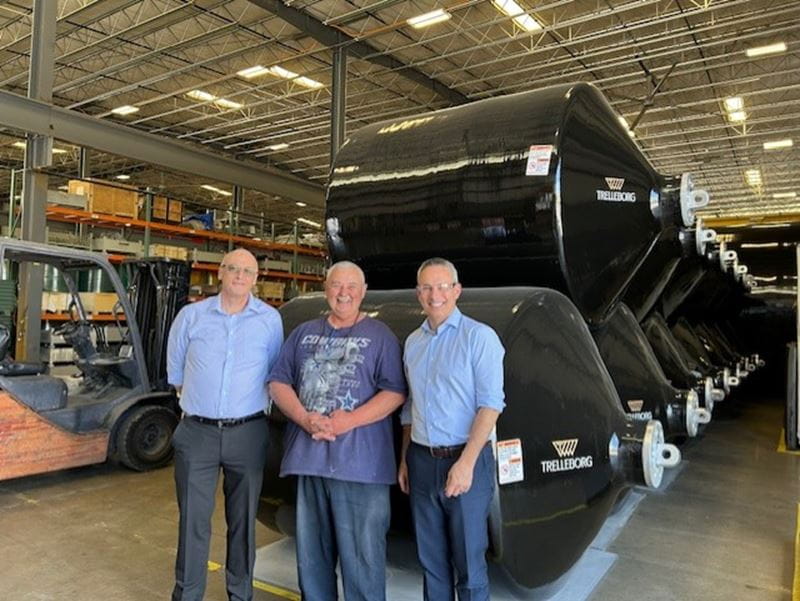
Gary Kitts joined the Berryville operation, a facility that manufactures marine foam fenders and heavy equipment for ports and vessels worldwide, in his final year of high school, on his father's recommendation. Fifty years later, as he steps into retirement, he leaves behind a career spent running shipping and receiving at the same site, managing the daily flow of material in and out of one of the operation's busiest functions. Before clocking out for the last time, he discusses about the work, the people, and what he's learned across five decades on the dock.
Fifty years is a long time in one place. What kept you here?
The job never sat still. The company grew, the operation changed, and I changed with it. I've done a little bit of everything over the years - you name it, I've probably touched it. That's what kept it interesting. It was never the same job twice.
I ran shipping and receiving. That meant unloading and loading trucks, managing inventory, keeping MRO supplies stocked and ordered, and making sure everything got received properly in the system. It's hands-on work. You're moving, you're lifting, you're keeping track of what's coming in and what's going out and making sure nothing falls through the cracks. I worked most closely with production and purchasing - production needs to know materials are ready; purchasing needs to know what's running low. There's a constant flow between the two, and you have to keep on top of it.
What's the expertise that builds up over 50 years in a role like this?
Logistics and inventory management, mostly how to move material efficiently and keep things organized so you're working ahead of the problem, not behind it. Beyond that, the practical things: forklift and material handling certifications, and working knowledge of the ERP system. It's not glamorous expertise, but it's the kind that keeps the operation moving. The other thing you build up is knowing the product. Most of my career was around marine foam fenders - the protective systems that sit between vessels and the quayside when ships come alongside. Big, heavy equipment that must be right because it's going out on the water. Accuracy matters with that kind of product. A mistake in shipping or receiving on a marine order isn't just an inconvenience, it can be a real challenge for the customer.
What's changed most over these decades?
Two things - technology and people. The technology side I could adapt to. When I started, it was all paper. Paper receivers, paper logs, handwritten everything. Now it's barcodes, scanning, ERP, automated tracking. That's just learning. I kept up with whatever the system was doing because the operation kept changing and I changed with it.
The people side was a bigger adjustment as the workforce has changed — what people prioritize, how they relate to work, what they're looking for from a job. It's a different relationship to the work than the one I grew up with. That was just the culture I knew, and adjusting to a different one took time.
What does it take to run shipping and receiving well?
People think shipping and receiving is just moving boxes. It's not. There's a lot of detailed work behind the scenes - inventory accuracy, system entries, dealing with truck drivers, making sure what's on the packing list matches what's actually in the shipment. When it's running smooth, nobody notices. When something's off, everybody notices. That's the nature of the job.
What kept you coming through the door, year after year?
Every day there was something to figure out, and it kept you sharp. But honestly, more than anything, it was the people. After 50 years, you're not just working with coworkers anymore, some of these people are lifelong friends. You've seen each other through everything - good times, hard times, all of it. That's not something you take for granted. I care about them deeply, and that's a big part of what got me in the door every morning.
What should the next generation of people coming into this kind of work focus on?
Treat people right. Your coworkers, the vendors, the truck drivers, treat them like they matter, because they do. A little respect and a genuine hello goes a long way. You'd be amazed by what people will do for you when you treat them well. I had the same drivers and vendors coming around for years, and a big part of that was because we treated each other right.
Looking back over 50 years, what's grown more important to you over time?
Family. It's not that it wasn't always important, it was, but the older I got, the more it moved to the center of things. People on the dock see the funny guy, the competitive guy, the one keeping everyone on their toes, and that's all real. What sits underneath it, though, is how much the people at home matter. You get perspective with age.
A principle you tried to bring into the work through the years?
Be honest. Be patient. And talk to people. Those three things will get you through just about anything.
Gary Kitts served as a Shipping and Receiving Associate at Trelleborg Marine and Infrastructure’s Berryville, Virginia facility for 50 years. He retired in June 2026. The Berryville site manufactures marine foam fenders used at ports and terminals worldwide.
Fifty years is a long time in one place. What kept you here?
The job never sat still. The company grew, the operation changed, and I changed with it. I've done a little bit of everything over the years - you name it, I've probably touched it. That's what kept it interesting. It was never the same job twice.
I ran shipping and receiving. That meant unloading and loading trucks, managing inventory, keeping MRO supplies stocked and ordered, and making sure everything got received properly in the system. It's hands-on work. You're moving, you're lifting, you're keeping track of what's coming in and what's going out and making sure nothing falls through the cracks. I worked most closely with production and purchasing - production needs to know materials are ready; purchasing needs to know what's running low. There's a constant flow between the two, and you have to keep on top of it.
What's the expertise that builds up over 50 years in a role like this?
Logistics and inventory management, mostly how to move material efficiently and keep things organized so you're working ahead of the problem, not behind it. Beyond that, the practical things: forklift and material handling certifications, and working knowledge of the ERP system. It's not glamorous expertise, but it's the kind that keeps the operation moving. The other thing you build up is knowing the product. Most of my career was around marine foam fenders - the protective systems that sit between vessels and the quayside when ships come alongside. Big, heavy equipment that must be right because it's going out on the water. Accuracy matters with that kind of product. A mistake in shipping or receiving on a marine order isn't just an inconvenience, it can be a real challenge for the customer.
What's changed most over these decades?
Two things - technology and people. The technology side I could adapt to. When I started, it was all paper. Paper receivers, paper logs, handwritten everything. Now it's barcodes, scanning, ERP, automated tracking. That's just learning. I kept up with whatever the system was doing because the operation kept changing and I changed with it.
The people side was a bigger adjustment as the workforce has changed — what people prioritize, how they relate to work, what they're looking for from a job. It's a different relationship to the work than the one I grew up with. That was just the culture I knew, and adjusting to a different one took time.
What does it take to run shipping and receiving well?
People think shipping and receiving is just moving boxes. It's not. There's a lot of detailed work behind the scenes - inventory accuracy, system entries, dealing with truck drivers, making sure what's on the packing list matches what's actually in the shipment. When it's running smooth, nobody notices. When something's off, everybody notices. That's the nature of the job.
What kept you coming through the door, year after year?
Every day there was something to figure out, and it kept you sharp. But honestly, more than anything, it was the people. After 50 years, you're not just working with coworkers anymore, some of these people are lifelong friends. You've seen each other through everything - good times, hard times, all of it. That's not something you take for granted. I care about them deeply, and that's a big part of what got me in the door every morning.
What should the next generation of people coming into this kind of work focus on?
Treat people right. Your coworkers, the vendors, the truck drivers, treat them like they matter, because they do. A little respect and a genuine hello goes a long way. You'd be amazed by what people will do for you when you treat them well. I had the same drivers and vendors coming around for years, and a big part of that was because we treated each other right.
Looking back over 50 years, what's grown more important to you over time?
Family. It's not that it wasn't always important, it was, but the older I got, the more it moved to the center of things. People on the dock see the funny guy, the competitive guy, the one keeping everyone on their toes, and that's all real. What sits underneath it, though, is how much the people at home matter. You get perspective with age.
A principle you tried to bring into the work through the years?
Be honest. Be patient. And talk to people. Those three things will get you through just about anything.
Gary Kitts served as a Shipping and Receiving Associate at Trelleborg Marine and Infrastructure’s Berryville, Virginia facility for 50 years. He retired in June 2026. The Berryville site manufactures marine foam fenders used at ports and terminals worldwide.