
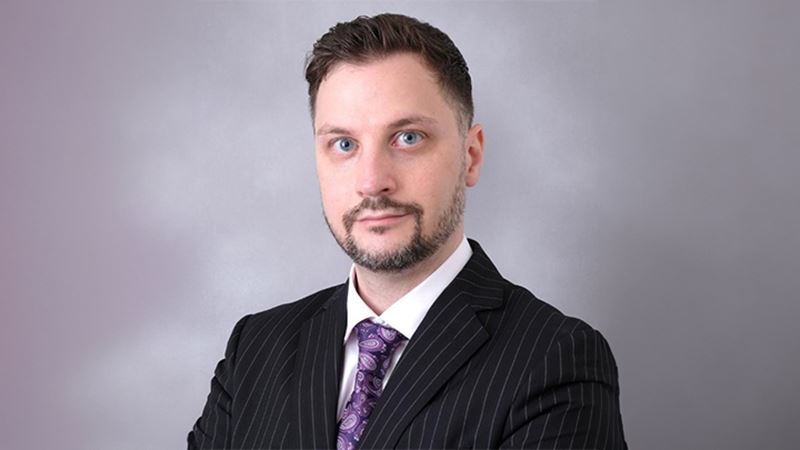
Meet the Pioneers - Aaron Hefurth
Date: 29.04.26
Delivering a marine fender project on time, on budget, and without compromise sounds straightforward in a brief. In practice, it spans multiple countries, supply chains, regulatory frameworks, and customer relationships - often simultaneously. Aaron Herfurth, Project Engineer for Trelleborg Marine & Infrastructure in Japan, operates precisely at that intersection every day. In this conversation, he shares what the work actually demands, where the industry is heading, and the mindset that turns complex delivery challenges into defining results.
Your background is in nuclear power, a very different sector. How did that translate into marine infrastructure, and what drew you to Trelleborg?
The industry changed, but the skill set didn't need to. My years in nuclear power were built around sales, ISO 9001 compliance, quality assurance, and project engineering; disciplines that are, if anything, more demanding in that environment than in most others. When the nuclear market cooled, I looked for a sector where that rigor would be genuinely valued. Marine infrastructure turned out to be a natural fit.
Trelleborg specifically came up through LinkedIn. What stood out wasn't just the role, it was the leadership quality of the General Manager in Japan and the clear growth momentum of the business in the Japanese market. That combination told me this would be a place where ambitious work was expected and supported. The decision felt strategic, not opportunistic.
How has your role evolved since joining, and what does your portfolio actually cover today?
Marine fenders are still the core, but the scope has widened considerably. I now also support Docking & Mooring and Navigation projects, which means I'm engaged across the full Marine & Infrastructure portfolio. The expansion has been organic, each product area demands the same disciplined project approach, even when the technical specifics differ.
The result is a role that genuinely spans every stage of the project lifecycle: from reviewing customer and regulatory requirements and coordinating design with our India Center of Excellence, through managing supplier schedules, handling non-conformances, coordinating logistics, and in some cases witnessing installation on site. It's end-to-end in the truest sense.
Marine fender delivery is often perceived as a logistics exercise. What does it actually involve that outsiders tend to underestimate?
The logistics piece is real, but it's only one layer. The more demanding work is in the alignment, ensuring that what the customer specified, what the design reflects, what the manufacturer produces, and what ultimately arrives on site are all the same thing. That coherence doesn't happen automatically. It requires active coordination across multiple internal and external stakeholders, often across time zones and languages.
My internal network alone includes local Sales teams, the India Center of Excellence, manufacturing teams at our facility in Qingdao, China and Berryville, and the project management function in Asia-Pacific (APAC). Externally, I'm managing relationships with both customers and suppliers simultaneously, each with their own timelines, priorities, and risk profiles. The engineering is often the straightforward part. The coordination is where projects can succeed or fail.
You're also involved in Specialists Center of Port and Airport Engineering (SCOPE) and the CDIT working group. How does industry-level engagement shape day-to-day project work?
Both are important for staying connected to where standards are heading. SCOPE is the Japanese certifying body for fender quality assessment and being part of that process gives direct visibility into how quality is evaluated in this market, which directly informs how I manage supplier documentation and manufacturing review. The CDIT working group on rubber fender testing standards sits at the frontier of how performance criteria are being defined and updated globally.
This kind of involvement matters because it means technical requirements aren't being interpreted second-hand, infact they're being shaped and understood at the source. That translates into projects where quality claims are substantiated, not assumed.
Can you walk us through a project where the standard approach simply wasn't going to work, and what you did instead?
Japan's first roller fender project is the clearest example. Six roller fenders, a three-month delivery window, and a critical component - Orkot bearings housed within the roller assemblies - whose standard manufacturing lead time made on-time delivery structurally impossible. The default response in that situation is to renegotiate the timeline. I didn't think that was the right move.
Instead, I identified an alternative fabrication partner with the capability to produce the Orkot components, negotiated terms that matched cost while dramatically compressing lead time, and maintained our Purchase Excellence savings throughout. The result was on-time delivery, cost neutrality, and the first successful roller fender installation in Japan with strong customer feedback after they saw the system in operation.
The lesson wasn't about being clever. It was about refusing to treat a constraint as a conclusion before you've properly tested whether alternatives exist.
You were also part of the global first operational use of Dynamoor, a significant milestone for Docking & Mooring. What made that project particularly complex?
Several things converged at once. We were supporting installation and Site Acceptance Testing for a Japanese utility on an active wharf which meant installation windows shifted regularly, with no ability to simply pause operations and wait. Localization added another dimension: Japanese-language support for documentation, contractor training, and communication required careful management throughout.
I learned the Dynamoor system's operation in real time, coordinated faster-than-planned installation windows, trained contractors on site, and ensured safety and quality were maintained — while still running my broader marine fender portfolio in parallel. What made the outcome significant wasn't just that we delivered; it was that this was the first time Dynamoor had been operationally installed anywhere in the world. That carries weight, both for the customer's confidence and for the global Docking & Mooring market.
For maritime and infrastructure leaders planning projects today — what's the single most important shift you'd flag in the current environment?
Overseas shipment risk. It has become meaningfully more volatile over the past few years, driven largely by geopolitical shifts that affect both routing and lead times. What was once a manageable variable has become something that requires deliberate planning - realistic schedule margin is no longer optional, it's a fundamental part of how responsible project planning is done.
Communicating delivery timelines to customers has real implications. Overpromising on schedules isn't just a commercial risk, it's a trust risk. Building credibility around honest, margin-aware timelines is increasingly a differentiator.
What's a misconception about marine project delivery that you'd like to correct, particularly for teams on the customer side?
That project schedules are fixed and linear. In reality, schedules are dynamic documents with built-in flexibility designed to absorb the variability that's inherent in manufacturing and logistics. When that flexibility is used well, it's not a sign of weak planning, it's a sign that the plan was realistic to begin with.
There's also a question I'd encourage customers to ask far more often: "Do you think this requirement is actually necessary?" Unchallenged specifications can introduce real cost, lead-time risk, or impractical constraints without delivering any meaningful value to the end system. Questioning requirements collaboratively and early saves time and money for everyone.
What's the professional approach or capability you'd point to as most directly responsible for your outcomes?
Developing multiple scenarios for a complex problem and having a credible solution ready for each. When the standard path closes off, as it sometimes might, you need to have already thought through alternatives. The roller fender project I mentioned earlier in this discussion worked because I wasn't starting from zero when the lead time for Orkot bearings became a challenge. Preparation enables adaptation.
Equally important is ensuring all perspectives are genuinely heard before decisions are made. Engineering, sales, management, and suppliers together bring a lens that the others may not necessarily have. The decisions I've seen go wrong have almost always excluded one of those voices too early. Good collaboration isn't just a value; it's a practical risk-reduction tool.
What are you currently thinking about or exploring that you expect to matter more in the next few years?
How AI can meaningfully assist with project engineering and documentation-heavy workflows. A significant proportion of time in this role is spent managing documents, tracking requirements across stakeholders, and coordinating communications, work that is important but doesn't necessarily require human judgment at every step. I'm genuinely interested in where intelligent tools can reduce that friction without introducing new risks around accuracy or accountability.
For teams thinking about operational efficiency, this isn't a distant consideration, it's worth exploring now. The project engineering workflow has significant untapped potential for augmentation, and early movers will likely find real advantages.
YOUR NEXT STEP
If you're planning a marine infrastructure project in the APAC region, contact Aaron Hefurth:
Your background is in nuclear power, a very different sector. How did that translate into marine infrastructure, and what drew you to Trelleborg?
The industry changed, but the skill set didn't need to. My years in nuclear power were built around sales, ISO 9001 compliance, quality assurance, and project engineering; disciplines that are, if anything, more demanding in that environment than in most others. When the nuclear market cooled, I looked for a sector where that rigor would be genuinely valued. Marine infrastructure turned out to be a natural fit.
Trelleborg specifically came up through LinkedIn. What stood out wasn't just the role, it was the leadership quality of the General Manager in Japan and the clear growth momentum of the business in the Japanese market. That combination told me this would be a place where ambitious work was expected and supported. The decision felt strategic, not opportunistic.
How has your role evolved since joining, and what does your portfolio actually cover today?
Marine fenders are still the core, but the scope has widened considerably. I now also support Docking & Mooring and Navigation projects, which means I'm engaged across the full Marine & Infrastructure portfolio. The expansion has been organic, each product area demands the same disciplined project approach, even when the technical specifics differ.
The result is a role that genuinely spans every stage of the project lifecycle: from reviewing customer and regulatory requirements and coordinating design with our India Center of Excellence, through managing supplier schedules, handling non-conformances, coordinating logistics, and in some cases witnessing installation on site. It's end-to-end in the truest sense.
Marine fender delivery is often perceived as a logistics exercise. What does it actually involve that outsiders tend to underestimate?
The logistics piece is real, but it's only one layer. The more demanding work is in the alignment, ensuring that what the customer specified, what the design reflects, what the manufacturer produces, and what ultimately arrives on site are all the same thing. That coherence doesn't happen automatically. It requires active coordination across multiple internal and external stakeholders, often across time zones and languages.
My internal network alone includes local Sales teams, the India Center of Excellence, manufacturing teams at our facility in Qingdao, China and Berryville, and the project management function in Asia-Pacific (APAC). Externally, I'm managing relationships with both customers and suppliers simultaneously, each with their own timelines, priorities, and risk profiles. The engineering is often the straightforward part. The coordination is where projects can succeed or fail.
You're also involved in Specialists Center of Port and Airport Engineering (SCOPE) and the CDIT working group. How does industry-level engagement shape day-to-day project work?
Both are important for staying connected to where standards are heading. SCOPE is the Japanese certifying body for fender quality assessment and being part of that process gives direct visibility into how quality is evaluated in this market, which directly informs how I manage supplier documentation and manufacturing review. The CDIT working group on rubber fender testing standards sits at the frontier of how performance criteria are being defined and updated globally.
This kind of involvement matters because it means technical requirements aren't being interpreted second-hand, infact they're being shaped and understood at the source. That translates into projects where quality claims are substantiated, not assumed.
Can you walk us through a project where the standard approach simply wasn't going to work, and what you did instead?
Japan's first roller fender project is the clearest example. Six roller fenders, a three-month delivery window, and a critical component - Orkot bearings housed within the roller assemblies - whose standard manufacturing lead time made on-time delivery structurally impossible. The default response in that situation is to renegotiate the timeline. I didn't think that was the right move.
Instead, I identified an alternative fabrication partner with the capability to produce the Orkot components, negotiated terms that matched cost while dramatically compressing lead time, and maintained our Purchase Excellence savings throughout. The result was on-time delivery, cost neutrality, and the first successful roller fender installation in Japan with strong customer feedback after they saw the system in operation.
The lesson wasn't about being clever. It was about refusing to treat a constraint as a conclusion before you've properly tested whether alternatives exist.
You were also part of the global first operational use of Dynamoor, a significant milestone for Docking & Mooring. What made that project particularly complex?
Several things converged at once. We were supporting installation and Site Acceptance Testing for a Japanese utility on an active wharf which meant installation windows shifted regularly, with no ability to simply pause operations and wait. Localization added another dimension: Japanese-language support for documentation, contractor training, and communication required careful management throughout.
I learned the Dynamoor system's operation in real time, coordinated faster-than-planned installation windows, trained contractors on site, and ensured safety and quality were maintained — while still running my broader marine fender portfolio in parallel. What made the outcome significant wasn't just that we delivered; it was that this was the first time Dynamoor had been operationally installed anywhere in the world. That carries weight, both for the customer's confidence and for the global Docking & Mooring market.
For maritime and infrastructure leaders planning projects today — what's the single most important shift you'd flag in the current environment?
Overseas shipment risk. It has become meaningfully more volatile over the past few years, driven largely by geopolitical shifts that affect both routing and lead times. What was once a manageable variable has become something that requires deliberate planning - realistic schedule margin is no longer optional, it's a fundamental part of how responsible project planning is done.
Communicating delivery timelines to customers has real implications. Overpromising on schedules isn't just a commercial risk, it's a trust risk. Building credibility around honest, margin-aware timelines is increasingly a differentiator.
What's a misconception about marine project delivery that you'd like to correct, particularly for teams on the customer side?
That project schedules are fixed and linear. In reality, schedules are dynamic documents with built-in flexibility designed to absorb the variability that's inherent in manufacturing and logistics. When that flexibility is used well, it's not a sign of weak planning, it's a sign that the plan was realistic to begin with.
There's also a question I'd encourage customers to ask far more often: "Do you think this requirement is actually necessary?" Unchallenged specifications can introduce real cost, lead-time risk, or impractical constraints without delivering any meaningful value to the end system. Questioning requirements collaboratively and early saves time and money for everyone.
What's the professional approach or capability you'd point to as most directly responsible for your outcomes?
Developing multiple scenarios for a complex problem and having a credible solution ready for each. When the standard path closes off, as it sometimes might, you need to have already thought through alternatives. The roller fender project I mentioned earlier in this discussion worked because I wasn't starting from zero when the lead time for Orkot bearings became a challenge. Preparation enables adaptation.
Equally important is ensuring all perspectives are genuinely heard before decisions are made. Engineering, sales, management, and suppliers together bring a lens that the others may not necessarily have. The decisions I've seen go wrong have almost always excluded one of those voices too early. Good collaboration isn't just a value; it's a practical risk-reduction tool.
What are you currently thinking about or exploring that you expect to matter more in the next few years?
How AI can meaningfully assist with project engineering and documentation-heavy workflows. A significant proportion of time in this role is spent managing documents, tracking requirements across stakeholders, and coordinating communications, work that is important but doesn't necessarily require human judgment at every step. I'm genuinely interested in where intelligent tools can reduce that friction without introducing new risks around accuracy or accountability.
For teams thinking about operational efficiency, this isn't a distant consideration, it's worth exploring now. The project engineering workflow has significant untapped potential for augmentation, and early movers will likely find real advantages.
YOUR NEXT STEP
If you're planning a marine infrastructure project in the APAC region, contact Aaron Hefurth: