
Releasing the line: How automated mooring and docking systems unlock efficiency and emissions gains
Date: 07.04.26
By Nick Labrosse, Sales and Marketing Director, Docking and Mooring, Trelleborg Marine & Infrastructure. As seen in Drybulk Magazine, March 2026.
In a sector where marginal gains at berth can ripple across global supply chains, many ports and terminals still rely on antiquated mooring operations. Despite transformative automation across cargo handling, scheduling, and vessel navigation, the ship-to-shore interface remains heavily dependent on ropes, bollards, and line handlers – technologies and methods that have changed little in over a century.
For dry bulk terminals under pressure to improve throughput, reduce emissions, and protect personnel, this presents a critical choke point. Research from UCL suggests that cutting time spent at berth by just 10% could reduce voyage emissions by up to 25%. But to realise these gains, terminal operators must address operational inefficiencies hidden in plain sight – starting with mooring and docking.
The case for change: Risk, delay, and decarbonization
Mooring is consistently ranked among the most dangerous phases of vessel operations. According to the UK P&I Club, over half of all mooring-related injuries involve parted lines. These incidents often occur during peak activity. This is when line tension, vessel drift, and environmental conditions converge, and when crew and dock workers are most exposed.
Delays during mooring and unmooring compound quickly in high-frequency bulk operations. On routes serving steel plants, grain terminals, or energy facilities, even minor delays affect conveyor availability, berth rotation, and downstream logistics. Mooring inefficiencies also increase fuel use during positioning and at idle, while reducing the effective window for cargo handling or battery charging for hybrid/electric vessels.
From a decarbonization standpoint, every minute at berth matters, especially when facing incoming regulatory pressure. FuelEU Maritime requires emissions cuts both at sea and in port, while EU taxonomy criteria and corporate Scope 3 accounting now extend to port-side emissions and lifecycle infrastructure performance. As such, emissions reductions from mooring automation are no longer just operational improvements, they’re increasingly part of the regulatory compliance equation.
Automating mooring operations also supports broader sustainability outcomes by reducing the time, personnel, and equipment involved in berthing. This leads to lower emissions, faster turnarounds, and decreased energy waste, increasing value for ports aiming to align with meeting ESG goals and decarbonization targets.
Vacuum mooring in practice: Minimizing movement, maximizing control
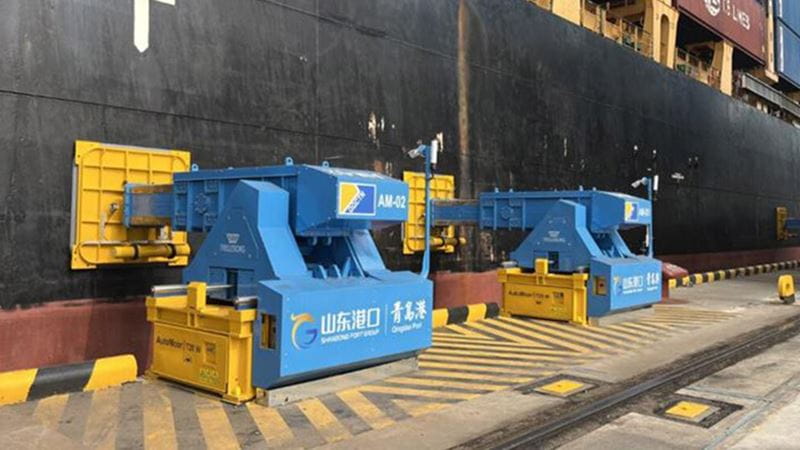
Vacuum mooring systems, such as Trelleborg’s AutoMoor, offer a proven alternative to legacy line-based approaches. Using smart, wharf-mounted vacuum pads that attach directly to a vessel’s hull, AutoMoor secures vessels in as little as 30 seconds and enables rapid departure in under 15.
Unlike fixed bollards, which depend on manual adjustment and introduce variability in line tension and vessel movement, AutoMoor applies consistent and adaptive mooring force in real time, counteracting wind, wave, and swell to keep the vessel stable. This stabilization is particularly beneficial during bulk loading and unloading, where even small vessel movements can disrupt cargo operations.
AutoMoor’s ability to reduce the influence of long-period waves and passing ship effects has been shown to widen the operational window of ports – a key advantage for dry bulk terminals experiencing downtime due to MetOcean conditions. In simulations involving long-period wave conditions, AutoMoor reduced peak vessel motions sufficiently to raise berth operability for product transfer from 65% to 95% – a significant gain in operational availability for bulk handling terminals.
Across over 30,000 successful vacuum mooring operations globally, terminals like the Port of Långnäs in Finland have reported mooring time reductions from 50 minutes to under one minute using AutoMoor[NL1.1]. This frees up valuable operational windows without compromising safety or control. In dry bulk contexts, where vessels frequently load or discharge under tight time constraints, these savings translate into lower demurrage risk, better schedule adherence, and more predictable terminal operations.
Johan Mannerus, Deputy Harbour Master at the Port of Långnäs, confirmed that the system holds the vessel in position better than the lines did, allowing loading and unloading to proceed without interruption even in high winds. Notably, the reduction in handling time translates into lower tug use and quicker power-down of main engines and thrusters – supporting both fuel efficiency and emissions reduction.
Beyond efficiency, vacuum mooring substantially improves safety for terminal personnel and vessel crews. By removing the need for line handling, crew exposure to snap-back zones and manual strain injuries are eliminated. Mannerus added that the most significant benefit has been the elimination of icy, manual rope handling which is a key risk factor in cold climates. Mooring can now be managed from a safe distance via control systems, and vessel movements are continuously monitored and adjusted by the vacuum pads themselves, removing the need for real-time manual correction.
Another example comes from Bastø Fosen’s ferry operations at the Moss-Horten crossing in Norway, where fast turnarounds are essential. The introduction of AutoMoor allowed vessel masters to switch off thrusters immediately upon mooring. As Captain Freddy Daniloff explained, once there is 100% vacuum, thrusters can be turned off and charging can begin. This means during loading, the vessel is not drawing propulsion or positioning energy, and batteries charge much faster. This is critical for electric or hybrid vessels, where time at berth directly affects charging efficiency and battery longevity.
Quantified data from an Australian terminal adds further weight to the case. Over a two-year period, use of vacuum mooring contributed to an estimated annual reduction of 117,000 litres of tug marine diesel oil, 286 tonnes of CO₂ emissions, and a saving of 470 hours or 19.5 days. These savings scale fast, and reductions in tug usage, idle time, and mooring delays directly translate to lower fuel costs, improved asset availability, and fewer schedule disruptions.
Docking data as an optimization tool: Introducing SmartDAS
Where AutoMoor focuses on the physical act of mooring, Trelleborg’s new SmartDAS system provides the digital visibility needed to further reduce risk, support optimization, and align with emissions and efficiency KPIs.
SmartDAS is a compact laser-based Docking Aid System that delivers real-time data on vessel approach angle, velocity, and distance during berthing. Its intuitive web interface integrates with AIS and environmental sensors, allowing pilots, terminal teams, and tugs to monitor docking operations in real time and retrospectively.
The system generates session-based reports that log berthing velocities, mooring forces, and environmental factors – key variables in both fender performance and incident analysis. This data supports port and terminal compliance with PIANC Working Group 211 Fender Design Guidelines 2024, which emphasize the need for site-specific insights to optimize fender sizing and reduce overengineering.
For dry bulk terminals, this capability can significantly enhance operational planning. SmartDAS data enables terminals to identify patterns in vessel behaviour that lead to delays or near misses, support insurance claims or incident investigations with time-stamped evidence and improve fender lifecycle planning by accurately capturing berthing energy and stress. The system can also benchmark and optimise tug use, mooring procedures, and vessel approach profiles, as well as inform future investments with high-resolution docking data that can be aggregated across berths or terminal zones.
SmartDAS also plays a key role in infrastructure optimization. As vessel sizes increase, ports face mounting pressure to accommodate larger vessels using existing berths. SmartDAS helps reduce the risk of abnormal impacts during berthing by delivering real-time information to adjust approach parameters. Used in combination with AutoMoor, it improves both physical safety and scheduling reliability while avoiding the need for major capital infrastructure upgrades.
By helping operators visualize and understand the docking process in granular detail, SmartDAS makes a traditionally manual phase of port operations measurable, optimizable, and digitally auditable.
System integration and implementation
Both AutoMoor and SmartDAS are designed for integration into existing port infrastructure with minimal disruption. AutoMoor can be retrofitted to quay walls or newbuild berths, with configurations adapted to vessel type, traffic patterns, and environmental conditions. SmartDAS requires only a modest hardware footprint and can be integrated with standard wireless networks – making it viable for both large terminals and single-berth operations.
Trelleborg’s implementation methodology focuses on collaboration with terminal engineers and port authorities to ensure system calibration aligns with site-specific operational priorities. This is critical in dry bulk environments, where berth types, vessel configurations, and environmental loads can vary significantly.
These systems also support long-term sustainability by enabling predictive maintenance, reducing strain on mooring infrastructure, and optimizing energy use. Smart sensors and data analytics reduce the need for reactive repairs and help extend the lifecycle of critical assets, all while supporting the transition to lower-carbon port operations.
A modern mooring standard
As global demand for bulk materials grows and the sustainability of their supply chains becomes a defining challenge, the efficiency and safety of mooring operations can no longer be treated as a secondary factor. Forward-looking ports and terminals are now recognizing mooring and docking as critical levers for performance. They are not just safety measures, they are strategic enablers of resilience, emissions reduction, and long-term competitiveness.
Technologies like AutoMoor and SmartDAS represent a step change in how ports approach the ship-to-shore interface, transforming mooring from a manual risk to a measurable, optimizable process.
For dry bulk terminals navigating tight margins, environmental regulations, and increasing vessel sizes, automated mooring and docking solutions provide a practical, cost-effective way to unlock capacity, enhance safety, and future-proof infrastructure, without sacrificing resilience. Adopting intelligent mooring and docking systems is no longer optional – it’s a strategic imperative for future-ready operations.
For dry bulk terminals under pressure to improve throughput, reduce emissions, and protect personnel, this presents a critical choke point. Research from UCL suggests that cutting time spent at berth by just 10% could reduce voyage emissions by up to 25%. But to realise these gains, terminal operators must address operational inefficiencies hidden in plain sight – starting with mooring and docking.
The case for change: Risk, delay, and decarbonization
Mooring is consistently ranked among the most dangerous phases of vessel operations. According to the UK P&I Club, over half of all mooring-related injuries involve parted lines. These incidents often occur during peak activity. This is when line tension, vessel drift, and environmental conditions converge, and when crew and dock workers are most exposed.
Delays during mooring and unmooring compound quickly in high-frequency bulk operations. On routes serving steel plants, grain terminals, or energy facilities, even minor delays affect conveyor availability, berth rotation, and downstream logistics. Mooring inefficiencies also increase fuel use during positioning and at idle, while reducing the effective window for cargo handling or battery charging for hybrid/electric vessels.
From a decarbonization standpoint, every minute at berth matters, especially when facing incoming regulatory pressure. FuelEU Maritime requires emissions cuts both at sea and in port, while EU taxonomy criteria and corporate Scope 3 accounting now extend to port-side emissions and lifecycle infrastructure performance. As such, emissions reductions from mooring automation are no longer just operational improvements, they’re increasingly part of the regulatory compliance equation.
Automating mooring operations also supports broader sustainability outcomes by reducing the time, personnel, and equipment involved in berthing. This leads to lower emissions, faster turnarounds, and decreased energy waste, increasing value for ports aiming to align with meeting ESG goals and decarbonization targets.
Vacuum mooring in practice: Minimizing movement, maximizing control
Vacuum mooring systems, such as Trelleborg’s AutoMoor, offer a proven alternative to legacy line-based approaches. Using smart, wharf-mounted vacuum pads that attach directly to a vessel’s hull, AutoMoor secures vessels in as little as 30 seconds and enables rapid departure in under 15.
Unlike fixed bollards, which depend on manual adjustment and introduce variability in line tension and vessel movement, AutoMoor applies consistent and adaptive mooring force in real time, counteracting wind, wave, and swell to keep the vessel stable. This stabilization is particularly beneficial during bulk loading and unloading, where even small vessel movements can disrupt cargo operations.
AutoMoor’s ability to reduce the influence of long-period waves and passing ship effects has been shown to widen the operational window of ports – a key advantage for dry bulk terminals experiencing downtime due to MetOcean conditions. In simulations involving long-period wave conditions, AutoMoor reduced peak vessel motions sufficiently to raise berth operability for product transfer from 65% to 95% – a significant gain in operational availability for bulk handling terminals.
Across over 30,000 successful vacuum mooring operations globally, terminals like the Port of Långnäs in Finland have reported mooring time reductions from 50 minutes to under one minute using AutoMoor[NL1.1]. This frees up valuable operational windows without compromising safety or control. In dry bulk contexts, where vessels frequently load or discharge under tight time constraints, these savings translate into lower demurrage risk, better schedule adherence, and more predictable terminal operations.
Johan Mannerus, Deputy Harbour Master at the Port of Långnäs, confirmed that the system holds the vessel in position better than the lines did, allowing loading and unloading to proceed without interruption even in high winds. Notably, the reduction in handling time translates into lower tug use and quicker power-down of main engines and thrusters – supporting both fuel efficiency and emissions reduction.
Beyond efficiency, vacuum mooring substantially improves safety for terminal personnel and vessel crews. By removing the need for line handling, crew exposure to snap-back zones and manual strain injuries are eliminated. Mannerus added that the most significant benefit has been the elimination of icy, manual rope handling which is a key risk factor in cold climates. Mooring can now be managed from a safe distance via control systems, and vessel movements are continuously monitored and adjusted by the vacuum pads themselves, removing the need for real-time manual correction.
Another example comes from Bastø Fosen’s ferry operations at the Moss-Horten crossing in Norway, where fast turnarounds are essential. The introduction of AutoMoor allowed vessel masters to switch off thrusters immediately upon mooring. As Captain Freddy Daniloff explained, once there is 100% vacuum, thrusters can be turned off and charging can begin. This means during loading, the vessel is not drawing propulsion or positioning energy, and batteries charge much faster. This is critical for electric or hybrid vessels, where time at berth directly affects charging efficiency and battery longevity.
Quantified data from an Australian terminal adds further weight to the case. Over a two-year period, use of vacuum mooring contributed to an estimated annual reduction of 117,000 litres of tug marine diesel oil, 286 tonnes of CO₂ emissions, and a saving of 470 hours or 19.5 days. These savings scale fast, and reductions in tug usage, idle time, and mooring delays directly translate to lower fuel costs, improved asset availability, and fewer schedule disruptions.
Docking data as an optimization tool: Introducing SmartDAS
Where AutoMoor focuses on the physical act of mooring, Trelleborg’s new SmartDAS system provides the digital visibility needed to further reduce risk, support optimization, and align with emissions and efficiency KPIs.
SmartDAS is a compact laser-based Docking Aid System that delivers real-time data on vessel approach angle, velocity, and distance during berthing. Its intuitive web interface integrates with AIS and environmental sensors, allowing pilots, terminal teams, and tugs to monitor docking operations in real time and retrospectively.
The system generates session-based reports that log berthing velocities, mooring forces, and environmental factors – key variables in both fender performance and incident analysis. This data supports port and terminal compliance with PIANC Working Group 211 Fender Design Guidelines 2024, which emphasize the need for site-specific insights to optimize fender sizing and reduce overengineering.
For dry bulk terminals, this capability can significantly enhance operational planning. SmartDAS data enables terminals to identify patterns in vessel behaviour that lead to delays or near misses, support insurance claims or incident investigations with time-stamped evidence and improve fender lifecycle planning by accurately capturing berthing energy and stress. The system can also benchmark and optimise tug use, mooring procedures, and vessel approach profiles, as well as inform future investments with high-resolution docking data that can be aggregated across berths or terminal zones.
SmartDAS also plays a key role in infrastructure optimization. As vessel sizes increase, ports face mounting pressure to accommodate larger vessels using existing berths. SmartDAS helps reduce the risk of abnormal impacts during berthing by delivering real-time information to adjust approach parameters. Used in combination with AutoMoor, it improves both physical safety and scheduling reliability while avoiding the need for major capital infrastructure upgrades.
By helping operators visualize and understand the docking process in granular detail, SmartDAS makes a traditionally manual phase of port operations measurable, optimizable, and digitally auditable.
System integration and implementation
Both AutoMoor and SmartDAS are designed for integration into existing port infrastructure with minimal disruption. AutoMoor can be retrofitted to quay walls or newbuild berths, with configurations adapted to vessel type, traffic patterns, and environmental conditions. SmartDAS requires only a modest hardware footprint and can be integrated with standard wireless networks – making it viable for both large terminals and single-berth operations.
Trelleborg’s implementation methodology focuses on collaboration with terminal engineers and port authorities to ensure system calibration aligns with site-specific operational priorities. This is critical in dry bulk environments, where berth types, vessel configurations, and environmental loads can vary significantly.
These systems also support long-term sustainability by enabling predictive maintenance, reducing strain on mooring infrastructure, and optimizing energy use. Smart sensors and data analytics reduce the need for reactive repairs and help extend the lifecycle of critical assets, all while supporting the transition to lower-carbon port operations.
A modern mooring standard
As global demand for bulk materials grows and the sustainability of their supply chains becomes a defining challenge, the efficiency and safety of mooring operations can no longer be treated as a secondary factor. Forward-looking ports and terminals are now recognizing mooring and docking as critical levers for performance. They are not just safety measures, they are strategic enablers of resilience, emissions reduction, and long-term competitiveness.
Technologies like AutoMoor and SmartDAS represent a step change in how ports approach the ship-to-shore interface, transforming mooring from a manual risk to a measurable, optimizable process.
For dry bulk terminals navigating tight margins, environmental regulations, and increasing vessel sizes, automated mooring and docking solutions provide a practical, cost-effective way to unlock capacity, enhance safety, and future-proof infrastructure, without sacrificing resilience. Adopting intelligent mooring and docking systems is no longer optional – it’s a strategic imperative for future-ready operations.