
Inside Parallel Motion: How Back-to-Back Super Cones Redefine Fender Physics
Date: 06.10.25
In marine fender design, there's a challenge which is all too familiar: balancing energy absorption requirements with structural loading limits. Higher energy absorption typically means higher reaction forces – a relationship that shapes most fender selection decisions.
Need higher energy absorption for larger vessels? Higher reaction forces and stronger structural design follow. Want to minimize structural loading? Energy absorption capacity must likely give way. It's a zero-sum game that's shaped marine infrastructure design for decades.
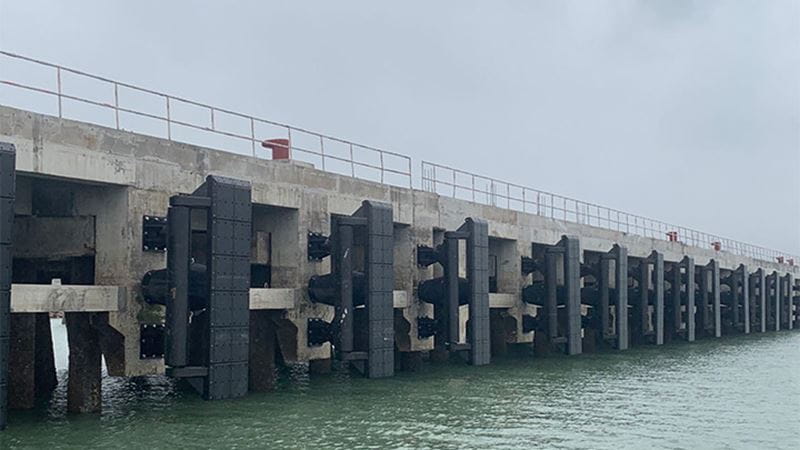
Trelleborg's Parallel Motion Fender technology breaks this paradigm. By using two Super Cones positioned back-to-back, the system achieves something that is impossible with conventional fender system: increasing energy absorption while maintaining or reducing the reaction forces.
The Dual Super Cone Breakthrough
The secret lies in two distinct engineering advantages: the vertical panel design and the innovative dual cone arrangement working in harmony.
The vertical panel maintains consistent contact with the vessel hull throughout the berthing process, a key feature that ensures reliable performance. But the real innovation happens inside the fender system with the dual cone arrangement.
The back-to-back Super Cone configuration allows the system to extend deflection travel significantly. This extended deflection capability enables the system to absorb substantially more energy while maintaining the same reaction force levels. Through controlled compression of the dual cone arrangement, the system achieves higher energy absorption without proportionally increasing the forces transmitted to the vessel hull or supporting structure.
Performance Under Real-World Conditions
Laboratory conditions are one thing. Real berthing operations are another. Consider this performance comparison of fenders at different berthing angles:
A dual cone PMF SCN1200 and conventional fender systems SCN1200 and SCK1450 all absorb approximately 2150 kNm in standardized conditions. However, at a 20° berthing angle the performance are very different:
• Parallel Motion Fender SCN1200 (F3.1 & F1.9): 2186.6 kNm energy absorption
• Super Cone (SCN1200 F2.8): 1612.6 kNm
• Cell Fender (SCK1450 E3.0): 1403.9 kNm
While conventional fenders lose significant performance at real life berthing angles, Parallel Motion Fenders maintains full energy absorption. The vertical panel geometry ensures consistent contact regardless of approach angle, while the internal Super Cone mechanism continues to manage forces effectively.
The reaction force story is equally compelling. At these energy levels, Parallel Motion generates reaction forces of 1956 kN compared to 3347 kN for conventional Super Cone designs. That's not incremental improvement, it's a fundamentally different structural loading profile.
Applications Across Challenging Environments
This performance consistency and the overall design features makes Parallel Motion Fenders viable across demanding applications where conventional fenders might have limitations:
• RoRo and fast ferry berths handling frequent, rapid turnarounds
• LNG and tanker terminals where absolute reliability is non-negotiable
• High tidal zones experiencing extreme vertical movement
• Monopole or 'soft' structures with limited reaction force capacity
Each application presents unique challenges, but the core engineering principle remains constant: maintain energy absorption while minimizing structural loading and keeping the fender panel vertical.
Designed for the Real World
Because Parallel Motion is a specialist fender system, proper selection requires thorough consultation with expert teams who understand the complexities of force analysis and application-specific requirements. The system's factory pre-assembly approach eases installation complexity and timeline management. Less field assembly means fewer variables and faster deployment.
While the dual Super Cone mechanism may seem straightforward, optimizing its performance for specific berthing conditions requires deep understanding of the underlying engineering and understanding how their non-tilt, free-rotation design provides consistent energy absorption.
Click on this link to watch our webinar where we explore these in detail and examine real-world case studies demonstrating how Parallel Motion Fenders is redefining marine fender performance.
Need higher energy absorption for larger vessels? Higher reaction forces and stronger structural design follow. Want to minimize structural loading? Energy absorption capacity must likely give way. It's a zero-sum game that's shaped marine infrastructure design for decades.
Trelleborg's Parallel Motion Fender technology breaks this paradigm. By using two Super Cones positioned back-to-back, the system achieves something that is impossible with conventional fender system: increasing energy absorption while maintaining or reducing the reaction forces.
The Dual Super Cone Breakthrough
The secret lies in two distinct engineering advantages: the vertical panel design and the innovative dual cone arrangement working in harmony.
The vertical panel maintains consistent contact with the vessel hull throughout the berthing process, a key feature that ensures reliable performance. But the real innovation happens inside the fender system with the dual cone arrangement.
The back-to-back Super Cone configuration allows the system to extend deflection travel significantly. This extended deflection capability enables the system to absorb substantially more energy while maintaining the same reaction force levels. Through controlled compression of the dual cone arrangement, the system achieves higher energy absorption without proportionally increasing the forces transmitted to the vessel hull or supporting structure.
Performance Under Real-World Conditions
Laboratory conditions are one thing. Real berthing operations are another. Consider this performance comparison of fenders at different berthing angles:
A dual cone PMF SCN1200 and conventional fender systems SCN1200 and SCK1450 all absorb approximately 2150 kNm in standardized conditions. However, at a 20° berthing angle the performance are very different:
• Parallel Motion Fender SCN1200 (F3.1 & F1.9): 2186.6 kNm energy absorption
• Super Cone (SCN1200 F2.8): 1612.6 kNm
• Cell Fender (SCK1450 E3.0): 1403.9 kNm
While conventional fenders lose significant performance at real life berthing angles, Parallel Motion Fenders maintains full energy absorption. The vertical panel geometry ensures consistent contact regardless of approach angle, while the internal Super Cone mechanism continues to manage forces effectively.
The reaction force story is equally compelling. At these energy levels, Parallel Motion generates reaction forces of 1956 kN compared to 3347 kN for conventional Super Cone designs. That's not incremental improvement, it's a fundamentally different structural loading profile.
Applications Across Challenging Environments
This performance consistency and the overall design features makes Parallel Motion Fenders viable across demanding applications where conventional fenders might have limitations:
• RoRo and fast ferry berths handling frequent, rapid turnarounds
• LNG and tanker terminals where absolute reliability is non-negotiable
• High tidal zones experiencing extreme vertical movement
• Monopole or 'soft' structures with limited reaction force capacity
Each application presents unique challenges, but the core engineering principle remains constant: maintain energy absorption while minimizing structural loading and keeping the fender panel vertical.
Designed for the Real World
Because Parallel Motion is a specialist fender system, proper selection requires thorough consultation with expert teams who understand the complexities of force analysis and application-specific requirements. The system's factory pre-assembly approach eases installation complexity and timeline management. Less field assembly means fewer variables and faster deployment.
While the dual Super Cone mechanism may seem straightforward, optimizing its performance for specific berthing conditions requires deep understanding of the underlying engineering and understanding how their non-tilt, free-rotation design provides consistent energy absorption.
Click on this link to watch our webinar where we explore these in detail and examine real-world case studies demonstrating how Parallel Motion Fenders is redefining marine fender performance.