
Proving durability: What field testing reveals about floating hose performance in CALM buoy operations
The findings show that hoses designed and manufactured with the objective of dependable operational performance can significantly reduce replacements, minimize operational risk and support more predictable OPEX. Within this context Trelleborg recognizes that in addition to factors such as safety and reliability, improved performance ultimately creates value through supporting maximum uptime, a vital operational metric.
CALM buoys remain one of the most important components in the global energy value chain, supporting safe and continuous offshore loading where fixed infrastructure is not viable or when weathervaning is a requirement to maximize the uptime of a terminal. Their role has become even more significant as operators navigate increasing pressure to enhance safety, minimize environmental impact, and optimize operational performance.
At the center of these systems are floating marine hoses, which must combine durability, reliability and consistency throughout their service life. As expectations rise and the balance between cost, performance and sustainability becomes more delicate, the ability of hoses to deliver long-term value matters more than ever.
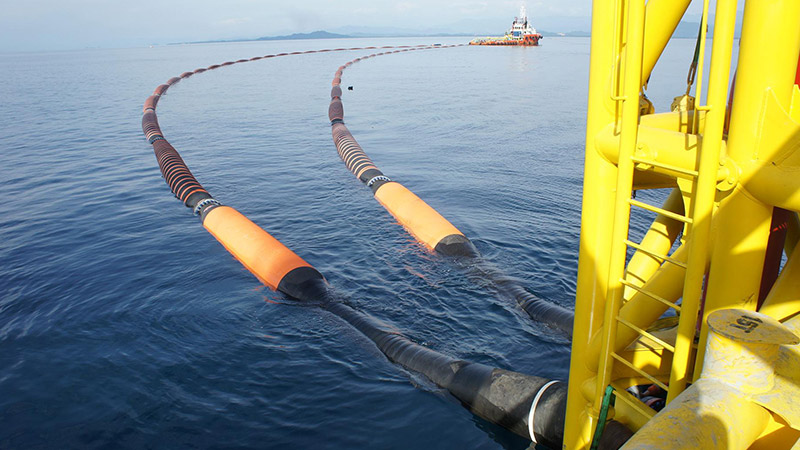
This context shaped the insights Trelleborg Oil & Marine shared at SLOM Jornada 2025, including a detailed study examining the residual performance of its KLELINE floating hoses retrieved directly from the field. KLELINE is a lightweight, nippleless, dual carcass hose with steel cord reinforcement. It is typically used in CALM buoy floating configurations.
The findings highlighted an important truth that investing in proven marine hoses delivers meaningful advantages over the long term. Durable hoses maintain their integrity over extended service periods, require fewer replacements, support safer operations and ultimately help operators reduce both maintenance demands and operational expenditure. In an industry where unplanned downtime and environmental risk carry significant consequences, the value of reliability cannot be overstated.
Putting performance to the test at Clermont-Ferrand
To understand how hoses perform after years in service, Trelleborg Oil & Marine retrieved three of its KLELINE hoses from the field and conducted a series of assessments designed to analyze the stresses experienced in real-world applications.
All tests were completed at the Clermont-Ferrand facility in France, where advanced in-house equipment and experienced engineering teams ensured precision and consistency across the program. The results not only met but frequently surpassed the performance thresholds required under GMPHOM, providing operators with a high level of confidence in long-term hose reliability.
Factory Acceptance Testing (FAT), carried out under tightly controlled conditions for both new hoses and those removed from service, provided insight into how Trelleborg’s hoses respond to long-term operational loads. By simulating years of service, engineers were able to observe how structural components, pressure-bearing layers and internal reinforcements held up over time, giving a clear picture of expected endurance.
Pressure integrity was evaluated through burst testing, which revealed that all Trelleborg hoses exceeded GMPHOM requirements by a significant margin. This level of performance is closely tied to the construction methods used. Almost all of the hoses tested burst at pressures superior to the GMPHOM requirements. This is largely attributable to the use of steel cords as reinforcement, a design choice that remains unique in the market and provides superior fatigue resistance and structural stability. Competitor hoses, which typically rely on alternative reinforcement techniques, have not demonstrated comparable results in equiva
lent testing conditions.
Material testing added another layer of insight, focusing on adhesion testing to examine the internal structure and bonding between layers which ensures layer integrity and service longevity. The internal steel cords in the hoses demonstrated exceptional durability, performing at or above the level of new, unused cords in fatigue testing.
Proven performance in the field
The most compelling evidence comes from operational data from the field. In this case, the Trelleborg hoses retrieved from the field, including those with long service histories and exposure to challenging conditions, demonstrated remarkably high performance. Around 95% of all of the hoses examined, performed above the GMPHOM standards expected for brand-new hoses. The dimensions and weight of KLELINE hoses also remained stable over time, indicating minimal deformation or structural deterioration.
Ageing of the inner liner varied between terminals, influenced by the specific characteristics of the product transported. Despite these differences, the hoses consistently maintained expected performance levels across regions and operating environments. The decline in burst resistance compared with what would be expected from a brand-new hose was generally modest, even in cases where hoses had operated for more than a decade. Steel cords within the DUAL carcass design continued to show high resilience, and adhesion values largely stayed within GMPHOM-defined ranges throughout extended service durations. This means continued operational performance from the hose.
Field examples further underline this durability. A hose retrieved after six years operating in sour service conditions in the Gulf of Thailand maintained their structural performance despite the corrosive environment. Another hose removed from Portugal after 12 years in service also showed exceptional integrity, demonstrating the long-term value that durable hose design brings to offshore operations.
The economics of durability: Why designing for predictable performance matters
The economic implications of these findings are considerable. Durable hoses reduce the frequency of replacements, lower the likelihood of failures and minimize unplanned interventions and repairs. This directly contributes to lower operational expenditure (OPEX) and minimizing reputational and environmental risks from potential spills. Avoiding failures not only protects the environment but also supports compliance with tightening regulatory expectations – including substantive progress towards meeting Scope 2 and 3 emissions objectives.
Despite this, procurement decisions in some parts of the industry still focus heavily on reducing purchasing price with little or no considerations to the total cost of ownership. While lower cost hoses may appear attractive initially, they often introduce higher long-term costs due to shorter service life, increased maintenance and greater operational risk. This creates a misleading economic equation, where short-term savings undermine lifecycle and wider operational efficiencies. By contrast, investing in proven hose technology enables operators to manage assets more predictably and cost-effectively.
Looking forward, the competitive positioning of CALM buoy operations will increasingly rely on taking advantage of dependable OPEX opportunities as and when they become known. The Trelleborg Oil & Marine presentation at SLOM showed valuable data that confirmed such opportunities currently exist; opportunities based on years of in-field operations and then clarified and confirmed with rigorous testing.
Dependable operating expenditure, predictable service intervals and consistent performance over the expected service life of the hose, enables commercial advantage for the operator. Reviewing expected service life towards a dependable longer period offers additional cost benefits. CALM buoy operators that keep a keen eye on such developments can only benefit when action is then taken to realize these opportunities.