
Engineering beneath the waves: Trelleborg Oil & Marine’s role in progressing offshore wind innovation
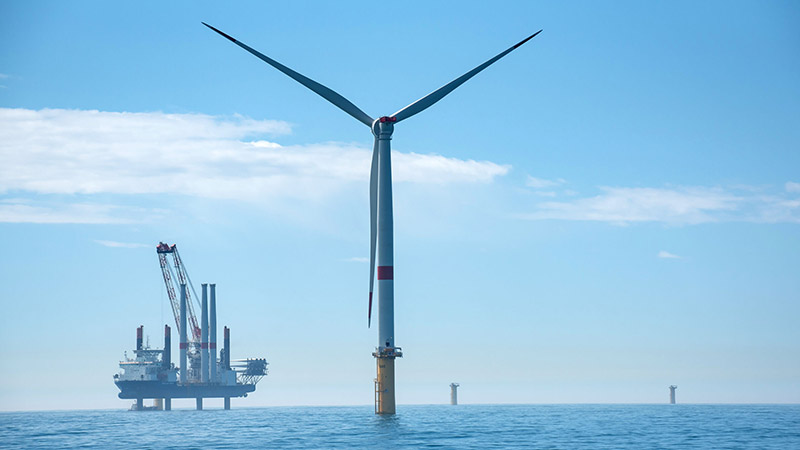
Also driving these projects forward is the innovation happening beneath the waves, where cutting-edge engineering meets the ocean floor. In Saint-Nazaire, Trelleborg Oil & Marine recently contributed to an offshore wind farm project led by Ocean Winds – a joint venture between Engie and EDP Renewables. By the end of 2025, the 480-MW Saint-Nazaire offshore wind farm is fully operational and generating approximately 1.7 terawatt-hours (TWh) of renewable electricity annually. This output provides enough energy to power roughly 700,000 people, or 20% of the Loire-Atlantique department's annual consumption.
One of the characteristics that makes supporting this project unique – and a world-first – is its approach to monopile installation. Taking inspiration from horizontal techniques to drill tunnels for subways, the customer explored vertical mechanized drilling for this project to safely install the foundations for wind turbines, even on rocky seabed.
Recognizing the challenges this installation would pose, the customer needed a bespoke hose solution that could withstand increased crushing loads and internal wearing. Trelleborg Oil & Marine was chosen to provide marine hoses that could transport slurry during the installation of wind turbines across the offshore wind farm.
Cross-sector collaboration and experience in play
The project required a highly specialized response and needed deep cross-sector expertise. Leveraging cross-divisional insights from within the business, Trelleborg developed a bespoke reeling marine hose. The team leveraged experience in mining applications, incorporating abrasion-resistant liners originally designed for handling mining debris. As a result, the hose was engineered to withstand the demanding conditions of offshore drilling.
Trelleborg was also able to advise on the use of a nippleless hose. Unlike conventional nipple hoses, which risk premature failure under tension and crushing when exposed to bending, Trelleborg’s nippleless construction offered a compact flange fully embedded in rubber. With a continuous inner liner and integrated gasket, the design improved durability while simplifying installation and maintenance.
To further support reliability, Trelleborg introduced a novel inspection feature: intermediate-colored layers within the inner liner. These layers acted as wear indicators, appearing during inspections and allowing operators to assess internal liner hose condition without disassembly. This proactive approach reduced downtime risks and enabled smarter maintenance planning.
Additionally, the hose’s inner rings were strengthened to accommodate the unique configuration where the hose sits on a reel. This design ensured resilience against high crushing loads, a critical requirement given the vertical drilling method and the slurry’s abrasive nature.
CAPEX vs. OPEX: The offshore wind equation
Offshore wind developers are taking a bigger-picture approach to cost. The logic is straightforward: operators with wind turbine installation vessels on the water and newbuilds on the way can charge as high as $300,000 per day contract, it makes little sense to cut costs on critical components like marine hoses.
The risk of not investing in premium performance products is significant. A single day of downtime for a wind turbine installation vessel can cost almost as much as the hose itself. If a hose were to fail and leave a vessel idle for 20 days, the financial consequences could quickly compromise the profitability of a project. For this reason, proven, high-dependable components become an essential safeguard against spiraling OPEX.
In the case of this project, Trelleborg’s nippleless construction provided an additional advantage: it reduced risk while ensuring operational reliability, which is exactly what offshore wind projects demand to withstand unique operating profiles and ensuring long-term project viability.
Lessons from the field
At the end of the project, detailed analysis and testing was carried out. The findings showed that hoses operating in a straight configuration remained in good condition after completion of the drilling campaign, while those subjected to bending displayed wear on the extrados of bends and needed to be scrapped at the end of the campaign.
žFor large-scale offshore wind developments, where projects may involve as many as 80 monopiles, this insight is critical. It shows that the hoses were able to deliver dependable performance throughout an extended, high-demand operational window, surpassing the requirements built into the project’s planning. While some sections will naturally show more wear and approach end-of-life sooner depending on their configuration and application, the overall performance confirms that the Trelleborg hoses can support the full campaign with reliability and consistency.
Post-project analysis underscored the importance of understanding operational dynamics and tailoring solutions accordingly. Ultimately, the hoses were designed for a specific project and they reliably met their objectives. This underscores the importance of balancing upfront investment with performance expectations, ensuring that equipment can withstand the campaign’s demands while minimizing unexpected downtime.
Supporting Europe’s offshore wind ambitions
As offshore wind ventures into deeper waters and more complex terrains, the demand for resilient, innovative components is expected to increase. Trelleborg’s contribution to these pioneering projects demonstrates how creative engineering solutions are contributing to making offshore energy projects more feasible, efficient and cost effective.